7 Support
COLABMO LEARNING · UPDATED 6 OCTOBER 2026
7 Support
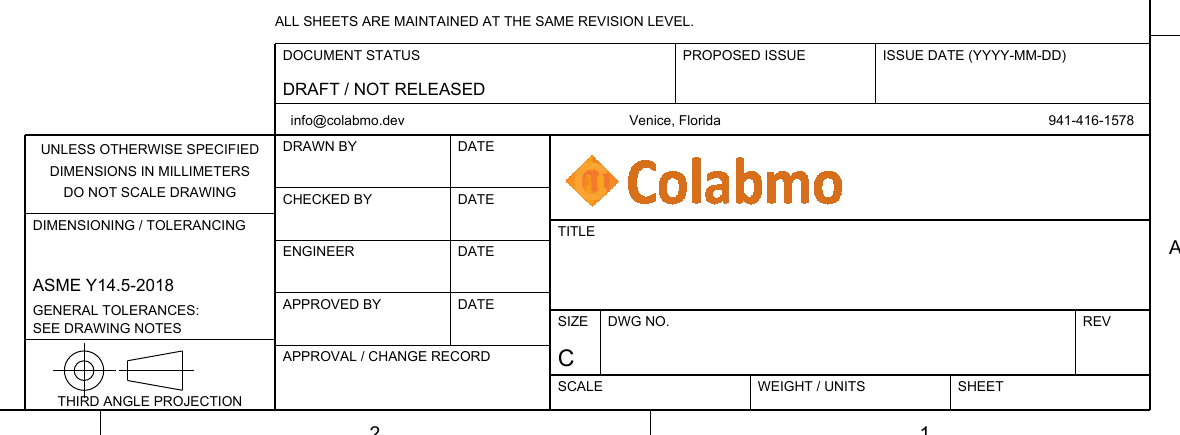
Look closely: Documented information needs an identifiable status. This draft title block shows fields for revision, issue date, checking and approval. An attractive template supports control; it does not prove a document has been approved.
Colabmo internal drawing-template example. Retained draft QA image, reused unchanged. This is a teaching example, not an issued drawing or evidence of approval.
2015 foundation. Clause references in this lesson refer to ISO 9001:2015. Continue to the 2026 addendum for the current revision and transition guidance. Practical tips are examples, not additional ISO requirements.
Navigating Section 7 of ISO9001:2015: Building a Strong Foundation with Support
Introduction: ISO9001:2015, a globally recognized quality management standard, emphasizes the importance of support in establishing, maintaining, and continually improving a quality management system (QMS). Section 7, "Support," outlines the specific requirements for resources, competence, awareness, communication, and documented information within the QMS. This article will explore the key components of Section 7, providing insights and practical advice for organizations seeking to comply with these requirements.
7.1 Resources: 7.1 focuses on the need for organizations to determine and provide the necessary resources for the QMS.
Practical Tips:
- Conduct a resource audit to identify existing internal resources and external providers.
- Regularly review and update the organization's resource allocation to ensure it aligns with the QMS's needs.
- Ensure that the infrastructure, including buildings, equipment, and technology, is adequate for the organization's processes.
7.1.5 Monitoring and Measuring Resources: Organizations must ensure that monitoring and measuring resources are suitable and maintained to provide valid and reliable results.
Practical Tips:
- Determine whether measurement traceability is required or essential for confidence in results. Apply calibration, verification or both as appropriate, and address equipment found unfit for its intended purpose.
- Maintain documented information as evidence of the fitness for purpose of monitoring and measuring resources.
7.2 Competence: 7.2 outlines the requirements for determining and ensuring the competence of personnel affecting the QMS's performance.
Practical Tips:
- Identify the necessary competence for each role within the organization.
- Provide training, mentoring, or other actions to acquire the necessary competence.
- Retain documented information as evidence of competence.
7.3 Awareness: 7.3 emphasizes the importance of ensuring that personnel are aware of the quality policy, quality objectives, and their contribution to the QMS.
Practical Tips:
- Develop a comprehensive awareness program that includes regular training and communication.
- Regularly assess personnel's awareness and understanding of the QMS.
7.4 Communication: 7.4 outlines the requirements for internal and external communication relevant to the QMS.
Practical Tips:
- Develop a communication plan that outlines what, when, with whom, and how to communicate.
- Ensure that communication is clear, concise, and accessible to all relevant stakeholders.
7.5 Documented Information: 7.5 focuses on the requirements for creating, updating, and controlling documented information within the QMS.
Practical Tips:
- Develop a document management system that includes identification, format, review, and approval processes.
- Ensure that documented information is accessible, protected, and controlled to prevent unintended alterations.
Conclusion: Section 7 of ISO9001:2015 provides a comprehensive framework for building a strong foundation of support within the QMS. By following the practical tips provided in this article, organizations can ensure they have the necessary resources, competence, awareness, communication, and documented information to establish and maintain an effective QMS that consistently delivers high-quality products and services.
There are no comments for now.
to be the first to leave a comment.