06 · Store, retrieve and retain usable evidence
Your outcome: Retrieve a complete record package and identify who owns its access, retention and recovery.
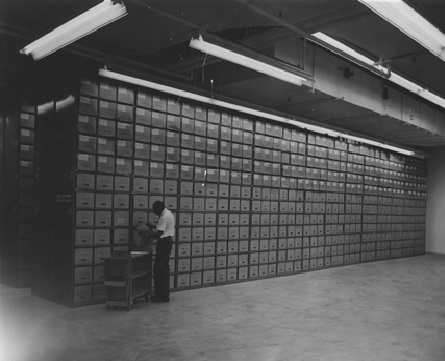
Look closely: Storage is only useful when evidence can be found. This historical archive illustrates labeled locations and organized retrieval. Apply the same principle to electronic folders, record identifiers, access and retention rules.
Federal Records Center, Suitland, Maryland, circa 1967. U.S. National Archives. Public domain (U.S. Government). Unmodified historical photograph.
.jpg)
Make the record findable
Choose the approved location and link it to a stable job, receipt, product, lot or other identifier. Record enough context to interpret it: title, relevant revision, date, author or source, status and associated records. Keep one designated source where practical and use links instead of uncontrolled copies. A convenient personal folder should not become the only place a business can retrieve its evidence.
Access has two purposes: authorized people can find what they need, and inappropriate viewing, alteration or deletion is restricted. Check permissions using the intended user's role. An administrator's successful search does not prove that a warehouse receiver can retrieve the required instruction.
Retain the complete meaning
A scan should be legible and complete, including reverse sides and attachments where relevant. Check the captured result before any disposition of the original. Follow the authorized scanning and retention process; do not assume that a scan automatically permits destruction of paper.
For electronic records, a PDF export may omit formulas, history, metadata or source measurements needed to interpret the result. Decide which files and associated context constitute the retained record. Test retrieval after a move or system change.
Know the retention rule
Identify the applicable retention period, the event that starts it, the responsible owner and any required hold. These depend on the record, contract and applicable obligations; this course does not prescribe a blanket number of years. When disposal is due, use the authorized process and check holds before deletion.
Backup supports recovery from loss; an archive supports controlled retention and retrieval. Confirm the actual arrangements rather than assuming that file synchronization provides both. A restore test is stronger evidence than a green backup icon alone.
Practice: retrieve the package
Using fictional files, start from shipment S-21. Find its order, picking or manufacturing record, required certificate, release evidence and source lot. Record missing links and time taken. Ask an authorized colleague using their normal access to repeat the retrieval.
Practice check: Complete the two questions attached to this lesson, then review the answer explanations before continuing.
There are no comments for now.
to be the first to leave a comment.